Al Qaeda Nuclear Program Of India
Al- Qaeda - Wikipedia. It has been designated as a terrorist group by the United Nations Security Council, the North Atlantic Treaty Organization (NATO), the European Union, the United States, Russia, India, and various other countries (see below). Al- Qaeda has mounted attacks on civilian and military targets in various countries, including the 1.
. Nuclear terrorism refers to an act of in which a person or people belonging to a detonates a. Some definitions of nuclear terrorism include the and/or the detonation of a radiological device, colloquially termed a, but consensus is lacking. In terms, nuclear terrorism is an offense committed if a person unlawfully and intentionally “uses in any way radioactive material with the intent to cause death or serious bodily injury; or with the intent to cause substantial damage to property or to the environment; or with the intent to compel a natural or legal person, an international organization or a State to do or refrain from doing an act”, according to the 2005 United Nations. The possibility of terrorist organizations using nuclear weapons (including those of a small size, such as those contained ) is something which is known of within U.S. Culture, and at times previously discussed within the political settings of the U.S. It is considered plausible that terrorists could acquire a nuclear weapon.
However, despite thefts and trafficking of small amounts of material, all low-concern and less than (SNM), there is no credible evidence that any terrorist group has succeeded in obtaining Category I SNM, the necessary multi-kilogram amounts of plutonium required to make a. Main article: Nuclear terrorism could include:.
Acquiring or fabricating a nuclear weapon. Fabricating a. Attacking a nuclear reactor, e.g., by disrupting critical inputs (e.g. Water supply).
Attacking or taking over a nuclear-armed submarine, plane or base. Nuclear terrorism, according to a 2011 report published by the at, can be executed and distinguished via four pathways:. The use of a nuclear weapon that has been stolen or purchased on the black market.
The use of a crude explosive device built by terrorists or by nuclear scientists who the terrorist organization has furtively recruited. The use of an explosive device constructed by terrorists and their accomplices using their own fissile material. The acquisition of fissile material from a nation-state. President called nuclear terrorism 'the single most important national security threat that we face'.
In his first speech to the U.N. Security Council, President Obama said that 'Just one nuclear weapon exploded in a city - be it New York or Moscow, Tokyo or Beijing, London or Paris - could kill hundreds of thousands of people'. It would 'destabilize our security, our economies, and our very way of life'.
History As early as December 1945, politicians worried about the possibility of smuggling nuclear weapons into the United States, though this was still in the context of a battle between the superpowers of the. Congressmen quizzed the 'father of the atomic bomb,', about the possibility of detecting a smuggled atomic bomb: Sen. Millikin: We.
Have mine-detecting devices, which are rather effective. I was wondering if anything of that kind might be available to use as a defense against that particular type of use of atomic bombs.
Oppenheimer: If you hired me to walk through the cellars of Washington to see whether there were atomic bombs, I think my most important tool would be a screwdriver to open the crates and look. I think that just walking by, swinging a little gadget would not give me the information. This sparked further work on the question of smuggled atomic devices during the 1950s. Discussions of non-state nuclear terrorism among experts go back at least to the 1970s. In 1975 warned that 'You can make a bomb with a few pounds of plutonium. By the mid-1980s the power stations may easily be turning out 200,000 lb of the stuff each year. And each year, unless present methods are drastically changed, many thousands of pounds of it will be transferred from one plant to another as it proceeds through the fuel cycle.
The dangers of robbery in transit are evident. Vigorous co-operation between governments and the International Atomic Energy Agency could, even at this late stage, make the looming perils loom a good deal smaller.' And the New York Times commented in 1981 that The 's 'origins go back to the aftershocks of the in mid-1972. Until that time, no one in the United States Government had thought seriously about the menace of organized, international terrorism, much less nuclear terrorism. There was a perception in Washington that the value of what is called 'special nuclear material' - plutonium or highly enriched uranium (HEU) - was so enormous that the strict financial accountability of the private contractors who dealt with it would be enough to protect it from falling into the wrong hands. But it has since been revealed that the physical safeguarding of bomb-grade material against theft was almost scandalously neglected.'
This discussion took on a larger public character in the 1980s after aired, a television dramatization of a nuclear terrorist attack on the United States. In 1986 a private panel of experts known as the released a report urging all nuclear-armed states to beware the dangers of terrorism and work on equipping their nuclear arsenals with. 'The probability of nuclear terrorism,' the experts warned, 'is increasing and the consequences for urban and industrial societies could be catastrophic.'
Is an organization which seeks to prevent nuclear terrorism and improve world nuclear security. It works alongside the. WINS was formed in 2008, less than a year after a break-in at the nuclear facility in, which contained enough to make several nuclear bombs. The (GICNT) is an international partnership of 86 nations and 4 official observers working to improve capacity on a national and international level for prevention, detection, and response to a nuclear terrorist event. Partners join the GICNT by endorsing the Statement of Principles, a set of broad nuclear security objectives.
GICNT partner nations organize and host workshops, conferences, and exercises to share best practices for implementing the Statement of Principles. The GICNT also holds Plenary meetings to discuss improvements and changes to the partnership. Militant groups materials on the are a global concern, and there is concern about the possible detonation of a small, crude nuclear weapon by a in a major city, with significant loss of life and property. It is feared that a terrorist group could detonate a, a type of. A dirty bomb is made of any radioactive source and a conventional explosive.
There would be no nuclear blast and likely no fatalities, but the radioactive material is dispersed and can cause extensive depending on the material used. A foot-long stick of radioactive cobalt could be taken from a food irradiation plant and combined with ten pounds of explosives to contaminate 1,000 square kilometers and make some areas uninhabitable for decades. There are other radiological weapons called radiological exposure devices where an explosive is not necessary. A radiological weapon may be very appealing to terrorist groups as it is highly successful in instilling fear and panic among a population (particularly because of the threat of ) and would contaminate the immediate area for some period of time, disrupting attempts to repair the damage and subsequently inflicting significant economic losses. Al-Qaeda According to Bunn & Wier, requested a ruling (a ), and was subsequently informed via a cleric of Saudi Arabia during 2003, of it being in accordance with for him to use a nuclear device against civilians if it were the only course of action available to him in a situation of defending Muslims against the actions of the U.S. According to leaked diplomatic documents, can produce radiological weapons, after sourcing nuclear material and recruiting rogue scientists to build 'dirty bombs'.
Al-Qaeda, along with some terrorist groups that seek to establish an in, have consistently stated they seek nuclear weapons and have tried to acquire them. Al-Qaeda has sought nuclear weapons for almost two decades by attempting to purchase stolen nuclear material and weapons and has sought nuclear expertise on numerous occasions. Osama bin Laden stated that the acquisition of nuclear weapons or other weapons of mass destruction is a “religious duty.” While pressure from a wide range of counter-terrorist activity has hampered Al-Qaeda’s ability to manage such a complex project, there is no sign that it has jettisoned its goals of acquiring. Statements made as recently as 2008 indicate that Al-Qaeda’s nuclear ambitions are still very strong. ISIS has demonstrated ambition to use weapons of mass destruction. Although the chances of them obtaining a nuclear bomb are small, the group have been trying/suspected of trying to obtain a nuclear. In July 2014, ISIS militants captured nuclear materials from.
In a letter to UN Secretary-General, Iraq's UN Ambassador said that the materials had been kept at the university and 'can be used in manufacturing weapons of mass destruction'. However, Nuclear experts regarded the threat as insignificant. Spokeswoman Gill Tudor said that the seized materials were 'low grade and would not present a significant safety, security or nuclear proliferation risk'. In October 2015 it was reported that authorities working with the FBI have stopped four attempts from 2010 to 2015 by gangs with suspected connections to Russia's intelligence services that sought to sell radioactive material to ISIS and other Middle Eastern extremists. The last reported case came in February 2015 when a smuggler with a large amount of radioactive caesium specifically sought a buyer from ISIS.
The Criminal organizations are thriving on black market nuclear materials in Moldova. Since relations between Russia and the West have deteriorated, it is difficult to know whether smugglers are succeeding in selling radioactive material originating from Russia to Islamist terrorists and elsewhere. In March 2016, it was reported that a senior Belgian nuclear official was being monitored by ISIS suspects linked to the leading Belgium authorities to suspect that ISIS was planning on abducting the official to obtain nuclear materials for a dirty bomb. In April 2016, EU and NATO security chiefs warned that ISIS are plotting to carry out nuclear attacks on the UK and Europe.
North Caucasus terrorists terrorists have attempted to seize a nuclear submarine armed with nuclear weapons. They have also engaged in reconnaissance activities on nuclear storage facilities and have repeatedly threatened to sabotage nuclear facilities. Similar to, these groups’ activities have been hampered by counter-terrorism activity; nevertheless they remain committed to launching such a devastating attack within. Aum Shinrikyo The Japanese terror cult, which used nerve gas to attack a subway in 1995, has also tried to acquire nuclear weapons. However, according to nuclear terrorism researchers at ’s, there is no evidence that they continue to do so.
Incidents involving nuclear material Information reported to the (IAEA) shows 'a persistent problem with the illicit trafficking in nuclear and other radioactive materials, thefts, losses and other unauthorized activities'. The IAEA Illicit Nuclear Trafficking Database notes 1,266 incidents reported by 99 countries over the last 12 years, including 18 incidents involving HEU or plutonium trafficking:. There have been 18 incidents of theft or loss of (HEU) and confirmed by the IAEA. British academic Shaun Gregory alleged in 2009 that terrorists had attacked Pakistani nuclear facilities three times; twice in 2007 and once in 2008. However, the then Director General said the claims were 'factually incorrect', adding that the sites were 'military facilities, not nuclear installations'. In November 2007, burglars with unknown intentions infiltrated the nuclear research facility near Pretoria, South Africa. The burglars escaped without acquiring any of the uranium held at the facility.
In June 2007, the released to the press the name of, allegedly the operations leader for developing tactical plans for detonating nuclear bombs in several American cities simultaneously. In November 2006, warned that were planning on using nuclear weapons against cities in the United Kingdom by obtaining the bombs via means. In February 2006, of was arrested in, along with three Georgian accomplices, with 79.5 grams of 89 percent HEU. In November 2006, the with radioactive polonium 'represents an ominous landmark: the beginning of an era of nuclear terrorism,' according to Andrew J. In June 2002, U.S. Citizen was arrested for allegedly planning a radiological attack on the city of Chicago; however, he was never charged with such conduct. He was instead convicted of charges that he conspired to 'murder, kidnap and maim' people overseas.
Pakistan In 2009, a paper published in 's journal alleged that 's nuclear sites had been attacked by al-Qaeda and the Taliban at least three times. However, Pakistan's military rejected the allegations., a political analyst, said that the nuclear link was 'absolute nonsense'. Interestingly, all three attacks were suicide and appeared to aim at causing maximum damage and not seizing weapons. In January 2010, it was revealed that the US army was training a specialised unit 'to seal off and snatch back' Pakistani nuclear weapons in the event that militants would obtain a nuclear device or materials that could make one. Pakistan supposedly possesses about 80 nuclear warheads.
US officials refused to speak on the record about the American safety plans. A study by the at titled 'Securing the Bomb 2010,' found that Pakistan's stockpile 'faces a greater threat from Islamic terror groups seeking nuclear weapons than any other nuclear stockpile on earth.' In 2016, Director said that Pakistan 'continues to take steps to improve its nuclear security, and is aware of the threat presented by extremists to its program'.
According to Rolf Mowatt-Larssen, a former investigator with the CIA and the US Department of Energy, there is 'a greater possibility of a nuclear meltdown in Pakistan than anywhere else in the world. The region has more violent extremists than any other, the country is unstable, and its arsenal of nuclear weapons is expanding.'
In 2015, press secretary said that the US has confidence that Pakistan is 'well aware of the range of potential threats to its nuclear arsenal'. He added that the US is 'confident that Pakistan has a professional and dedicated security force that understands the importance and the high priority that the world places on nuclear security'. Nuclear weapons expert and author of 'Peddling Peril' has also expressed concerns that Pakistan's stockpile may not be secure despite assurances by both Pakistan and U.S. He stated that Pakistan 'has had many leaks from its program of classified information and sensitive nuclear equipment, and so you have to worry that it could be acquired in Pakistan'.
In 2015, former US Ambassador to Pakistan, expressed confidence in the capabilities of the Pakistani security forces to control and secure its nuclear weapons. He added that Islamabad has 'specifically taken into account the insider threat'.
A 2016 study by the titled 'Pakistan's Nuclear Weapons', noted that Pakistan's 'initiatives, such as strengthened export control laws, improved personnel security, and international nuclear security cooperation programs, have improved Pakistan's nuclear security'. United States President has reviewed Homeland Security policy and concluded that 'attacks using.
Pose a serious and increasing national security risk'. In their presidential contest, President George W. Bush and Senator John Kerry both agreed that the most serious danger facing the United States is the possibility that terrorists could obtain a nuclear bomb. Most nuclear-weapon analysts agree that 'building such a device would pose few technological challenges to reasonably competent terrorists'. The main barrier is acquiring highly.
In 2004, Graham Allison, U.S. Assistant Secretary of Defense during the Clinton administration, wrote that “on the current path, a nuclear terrorist attack on America in the decade ahead is more likely than not'. In 2004, Bruce Blair, president of the stated: 'I wouldn't be at all surprised if nuclear weapons are used over the next 15 or 20 years, first and foremost by a terrorist group that gets its hands on a Russian nuclear weapon or a Pakistani nuclear weapon'. In 2006, Robert Galluccii, Dean of the Georgetown University School of Foreign Service, estimated that, “it is more likely than not that al-Qaeda or one of its affiliates will detonate a nuclear weapon in a U.S. City within the next five to ten years.' Despite a number of claims, there is no credible evidence that any terrorist group has yet succeeded in obtaining a nuclear bomb or the materials needed to make one.
Detonation of a nuclear weapon in a major U.S. City could kill more than 500,000 people and cause more than a trillion dollars in damage. Hundreds of thousands could die from fallout, the resulting fires and collapsing buildings. In this scenario, uncontrolled fires would burn for days and emergency services and hospitals would be completely overwhelmed. The likely socio-economic consequences in the United States outside the immediate vicinity of an attack, and possibly in other countries, would also likely be far-reaching.
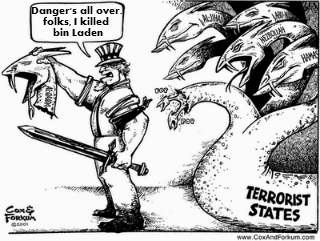
Al Qaeda Training
A report speculates that there may be an exodus from other urban centers by populations fearful of another nuclear attack. The Obama administration will focus on reducing the risk of high-consequence, non-traditional nuclear threats. Nuclear security is to be strengthened by enhancing 'nuclear detection architecture and ensuring that our own nuclear materials are secure,' and by 'establishing well-planned, well-rehearsed, plans for co-ordinated response.' According to senior Pentagon officials, the United States will make 'thwarting nuclear-armed terrorists a central aim of American strategic nuclear planning.'
Is another strategy being pursued to counter terrorism. Led by the National Technical Nuclear Forensics Center, attribution would allow the government to determine the likely source of nuclear material used in the event of a nuclear attack. This would prevent terrorist groups, and any states willing to help them, from being able to pull off a covert attack without assurance of retaliation. In July 2010 medical personnel from the U.S.
Army practiced the techniques they would use to treat people injured by an atomic blast. The exercises were carried out at a training center in Indiana, and were set up to 'simulate the aftermath of a small nuclear bomb blast, set off in a U.S. City by terrorists.'
Is a discovered in June 2010 that is believed to have been created by the and to attack Iran's nuclear facilities. Nuclear power plants After 9/11, were to be prepared for an attack by a large, well-armed terrorist group. But the, in revising its security rules, decided not to require that plants be able to defend themselves against groups carrying sophisticated weapons. According to a study by the Government Accountability Office, the N.R.C. Appeared to have based its revised rules 'on what the industry considered reasonable and feasible to defend against rather than on an assessment of the terrorist threat itself'. If terrorist groups could sufficiently damage safety systems to cause a at a nuclear power plant, and/or sufficiently damage pools, such an attack could lead to widespread. The have said that if nuclear power use is to expand significantly, nuclear facilities will have to be made extremely safe from attacks that could release massive quantities of radioactivity into the community.
New reactor designs have features of, which may help. In the United States, the NRC carries out 'Force on Force' (FOF) exercises at all Nuclear Power Plant (NPP) sites at least once every three years. The peace group have shown how nuclear weapons facilities can be penetrated, and the groups actions represent extraordinary breaches of security at plants in the United States. The has acknowledged the seriousness of the 2012 Plowshares action. Policy experts have questioned 'the use of private contractors to provide security at facilities that manufacture and store the government's most dangerous military material'. Hoaxes In late 1974, President was warned that the received a communication from an wanting $200,000 ($1,000,000 today) after claiming that a nuclear weapon had been placed somewhere in. A team of experts rushed in from the but their radiation detection gear arrived at a different airport.
Federal officials then rented a fleet of vans to carry concealed around the city but forgot to bring the tools they needed to install the equipment. The incident was later found to be a. However, the government's response made clear the need for an agency capable of effectively responding to such threats in the future. Later that year, President Ford created the (NEST), which under the is tasked with investigating the 'illegal use of nuclear materials within the United States, including terrorist threats involving the use of special nuclear materials'.
One of its first responses by the Nuclear Emergency Search/Support Team was in on November 23, 1976. An unknown group called the 'Days of Omega' had mailed an threat claiming it would explode radioactive containers of water all over the city unless paid $500,000 ($2,200,000 today). Presumably, the radioactive containers had been stolen from the, less than 150 miles to the southwest. Immediately, NEST flew in a support aircraft from and began searching for non-natural radiation, but found nothing. No one ever responded despite the elaborate instructions given, or made any attempt to claim the (fake) money which was kept under surveillance. Within days, the incident was deemed a hoax, though the case was never solved. To avoid panic, the public was not notified until a few years later.
Policy landscape Recovery The Cooperative Threat Reduction Program (CTR), which is also known as the, is a 1992 law sponsored by Senators Sam Nunn and Richard Lugar. The CTR established a program that gave the U.S. Department of Defense a direct stake in securing loose fissile material inside the since-dissolved USSR. According to, director of 's, this law is a major reason why not a single nuclear weapon has been discovered outside the control of Russia’s nuclear custodians.
The Belfer Center is itself running the Project on Managing the Atom, Matthew Bunn is a co-principal investigator of the project, Martin B. Malin is its executive director (circa. In August 2002, the launched a program to track and secure from 24 -style reactors in 16 countries, in order to reduce the risk of the materials falling into the hands of terrorists or '.
The first such operation was, 'a multinational, public-private effort to remove nuclear material from a poorly-secured.' The project has been hailed as 'a nonproliferation success story' with the 'potential to inform broader 'global cleanout' efforts to address one of the weakest links in the nuclear nonproliferation chain: insufficiently secured civilian nuclear research facilities.' In 2004, the U.S. Global Threat Reduction Initiative (GTRI) was established in order to consolidate nuclear stockpiles of (HEU), and assemble nuclear weapons at fewer locations.
Additionally, the GTRI converted HEU fuels to (LEU) fuels, which has prevented their use in making a nuclear bomb within a short amount of time. HEU that has not been converted to LEU has been shipped back to secure sites, while amplified security measures have taken hold around vulnerable nuclear facilities. Options , President of the, argues that traditional deterrence is not an effective approach toward terrorist groups bent on causing a nuclear catastrophe., stating the wide availability of nuclear weapons makes deterrence “decreasingly effective and increasingly hazardous.” Preventive strategies, which advocate the elimination of an enemy before it is able to mount an attack, are risky and controversial, therefore difficult to implement. Gallucci believes that “the United States should instead consider a policy of expanded deterrence, which focuses not on the would-be nuclear terrorists but on those states that may deliberately transfer or inadvertently lead nuclear weapons and materials to them. By threatening retaliation against those states, the United States may be able to deter that which it cannot physically prevent.”.
Makes a similar case, arguing that the key to expanded deterrence is coming up with ways of tracing nuclear material to the country that forged the fissile material. “After a nuclear bomb detonates, nuclear forensic cops would collect debris samples and send them to a laboratory for radiological analysis.
By identifying unique attributes of the fissile material, including its impurities and contaminants, one could trace the path back to its origin.” The process is analogous to identifying a criminal by fingerprints. “The goal would be twofold: first, to deter leaders of nuclear states from selling weapons to terrorists by holding them accountable for any use of their own weapons; second, to give every leader the incentive to tightly secure their nuclear weapons and materials.” Nuclear skeptics , a scholar of international relations at the, is a prominent nuclear skeptic. Harvard Kennedy School, Belfer Center for Science and International Affairs. Retrieved 28 January 2013. United Nations. Retrieved 13 April 2012., September 26, 2007. ^ Matthew Bunn.
Issues in Science and Technology, Winter 2005, p. ^ Ajay Singh. UCLA Today, February 11, 2009. Ruff, Tilman (November 2006), (PDF), energyscience.org.au. ^ Bunn, Matthew, Colonel Yuri Morozov, Rolf Mowatt-Larssen, Simon Saradzhyan, William Tobey, Colonel General (ret.) Viktor I. Yesin, and Major General (ret.) Pavel S.

Zolotarev (2011). Belfer Center for Science and International Affairs, Harvard University. Retrieved July 26, 2012. CS1 maint: Multiple names: authors list. Graham Allison (January 26, 2010).
Foreign Policy. Alex Kingsbury, ', U.S. News and World Report (February 18, 2007). 'Nuclear Terrorism,' The Economist (January 25, 1975) p.
Larry Collins, 'Combating Nuclear Terrorism,' New York Times (December 14, 1980) Sec. Sally Bedell, 'A Realistic Film Stirs NBC Debate,' New York Times (March 17, 1983) B13; Sally Bedell, 'NBC Nuclear Terror Show Criticized,' New York Times (March 22, 1983) C15; Aljean Harmetz, 'NBC Film on Terror Wins Prize,' New York Times (July 8, 1983) C19.
Costello, 'Experts Warn on Nuclear Terror,' Courier-Mail (June 26, 1986). The Washington Post, March 25, 2008. Brian Michael Jenkins. CNN.com, September 11, 2008. May 22, 2007, p. ^ Nicholas D.
The New York Times, March 10, 2004. Retrieved 2015-08-08. External link in publisher=. February 3, 2011. ^ Bunn, Matthew & Col-Gen. Maslin (2010).
Belfer Center for Science and International Affairs, Harvard University. Retrieved July 26, 2012. 7 October 2015.
The Huffington post. 8 October 2015. Cowell, Alan (10 July 2014).
The New York Times. Retrieved 15 July 2014. Sherlock, Ruth (10 July 2014). The Telegraph. Retrieved 15 July 2014. 7 October 2015.
The independent. 7 October 2015. The independent. 25 March 2016. 19 April 2016. ^ Bunn, Matthew. President and Fellows of Harvard College.
Retrieved 28 January 2013. ^ Nelson, Dean (11 August 2009). Retrieved 18 September 2017. ^ Walsh, Declan (12 August 2009). Retrieved 18 September 2017.
12 August 2009. Retrieved 18 September 2017.
Washington Post, December 20, 2007, Op-Ed by. June 4, 2007. Teather, David; Younge, Gary (January 5, 2005). The Guardian.
'Ushering in the era of nuclear terrorism,' by Patterson, Andrew J. MD, PhD, Critical Care Medicine, v. 35, p.953-954, 2007., 2010-04-12. ^ Paul K. Kerr, Mary Beth Nikitin. Retrieved 19 September 2017., 2010-04-12., 2010-04-13.
^ The White House. The New York Times, September 24, 2004.
^ Orde Kittrie. May 22, 2007, p.
Paul Williams (2005). The Al Qaeda Connection: International Terrorism, Organized Crime, and the Coming Apocalypse, Prometheus Books, pp.
Global Politician, September 11, 2007. Bleek, Philipp, Anders Corr, and Micah Zenko. The Houston Chronicle, May 1, 2005. by Charles Meade & Roger C.
Molander p 9, Retrieved March 11, 2013 - this report uses smuggled nuclear weapons in container ships at a US port as an example, so speculates an exodus from coastal cities. Thom Shanker and Eric Scmitt. The New York Times, December 18, 2009. Richelson, Jeffrey. George Washington University.
Deborah Block. Voice of America, 26 July 2010. Zetter, Kim (25 March 2013). Elizabeth Kolbert (28 March 2011).
The New Yorker. Daniel Hirsch et al. The NRC's Dirty Little Secret, Bulletin of the Atomic Scientists, May 1, 2003, vol. Ferguson & Frank A. Settle (2012).
Al Qaeda Nuclear Program Of Indiana
Federation of American Scientists. Kennette Benedict (9 August 2012). Bulletin of the Atomic Scientists. Department of Energy.
Retrieved 2012-10-21. Peck, Chris (1981-02-08). Retrieved 2012-10-21.
Peck, Chris (1981-02-08). The Spokesman-Review.
Retrieved 2012-10-21. Allison, Graham (December 29, 2011). The Huffington Post. Retrieved July 26, 2012. Bleek, 'Project Vinca: Lessons for Securing Civil Nuclear Material Stockpiles,' The Nonproliferation Review (Fall-Winter 2003) p.
Bunn, Matthew & Eben Harrell (2012). Belfer Center for Science and International Affairs, Harvard University. Retrieved July 26, 2012. Wier, Anthony and Matthew Bunn (November 19, 2006). The Washington Post.
Retrieved July 26, 2012. ^ Gallucci, Robert (September 2006). Annals of the American Academy of Political and Social Science.
607: 51–58.:. Retrieved 28 January 2013.
Kissinger, Henry (15 January 2008). Retrieved 28 January 2013. ^ Allison, Graham (13 March 2009).
Retrieved 28 January 2013. Mueller, John (15 January 2008).
University of Chicago. Atomic Obsession: Nuclear Alarmism from Hiroshima to Al-Qaeda: Oxford University Press.
Allison, Graham (2004). New York: Macmillan. Lieber, Keir; Press, Daryl (Summer 2013).
International Security. 38 (1): 80–84, 104. Tobey, William (2011). The Stanley Foundation. Retrieved July 26, 2012. Belfer Center for Science and International Affairs, Harvard University. Retrieved July 26, 2012.
Hope, Christopher (April 25, 2011). London: Telegraph.co.uk. Retrieved April 27, 2011. Gould, Martin. Retrieved April 27, 2011. April 25, 2011.
Retrieved April 27, 2011. Retrieved April 27, 2011. Further reading. (9 August 2004).
New York, New York:. Byrne, John and Steven M. Hoffman (1996). Governing the Atom: The Politics of Risk, Transaction Publishers.
(2009)., Black Inc. Ferguson, Charles D., and, with Amy Sands, Leonard S.
Spector and Fred L. Wehling (2004). Monterey, California:. CS1 maint: Multiple names: authors list. (2010) 2008. The Human Factor: Inside the CIA's Dysfunctional Intelligence Culture. Cambridge, Massachusetts:.
Lovins, Amory B. Price (1975)., Ballinger Publishing Company, 1975,. (2007).
New York, New York:. External links. from Harvard Kennedy School faculty and fellows.,.,., International Review of the Red Cross.,., Alsos Digital Library for Nuclear Issues. slideshow by.